Quick answer
At night, give guests a low, controllable route and localized reading light. Consider brightness, timing and spectrum together; do not infer sleep outcomes from CCT alone.
Hotel bedside lighting and blue light at night should be discussed as a room-exposure question, not a claim that one lamp colour guarantees better sleep. Human responses depend on when light is seen, how much reaches the eyes, its spectral content and the guest's prior exposure. A hotel can give guests control over evening intensity and keep unnecessary bright sources out of the resting eye line. It should also preserve enough task light to read and a safe route to move around. This guide sets design checks; it does not diagnose or promise a health outcome.
Consider timing and eye exposure together
Daylight, screens and electric lights all contribute to the guest's exposure. A source's correlated colour temperature, or CCT, describes its apparent colour but does not fully describe its spectrum or the quantity reaching the eye. A warm-looking lamp operated at high brightness may still be intrusive. A dimmer evening scene, shielding and the ability to switch the source off can matter as much as selecting a nominally warm CCT.
The US Department of Energy has discussed how evening light levels and blue-rich content can be relevant to circadian regulation. That is general research context, not a measured result for a particular MYDE fixture or a prediction for an individual guest. If a project has a specific circadian or clinical target, commission a specialist brief and appropriate measurements rather than turning an ordinary product label into a health claim.
Give the guest useful choices
Plan a distinct arrival scene, local reading scene and low-level night route. The guest should be able to stop the reading light without extinguishing every means of orientation. If two people share a bed, one person's reading head should avoid direct spill into the other person's eyes. Check the switch and any dimming control from the pillow. The room lighting for sleep and relaxation guide covers the wider evening sequence.
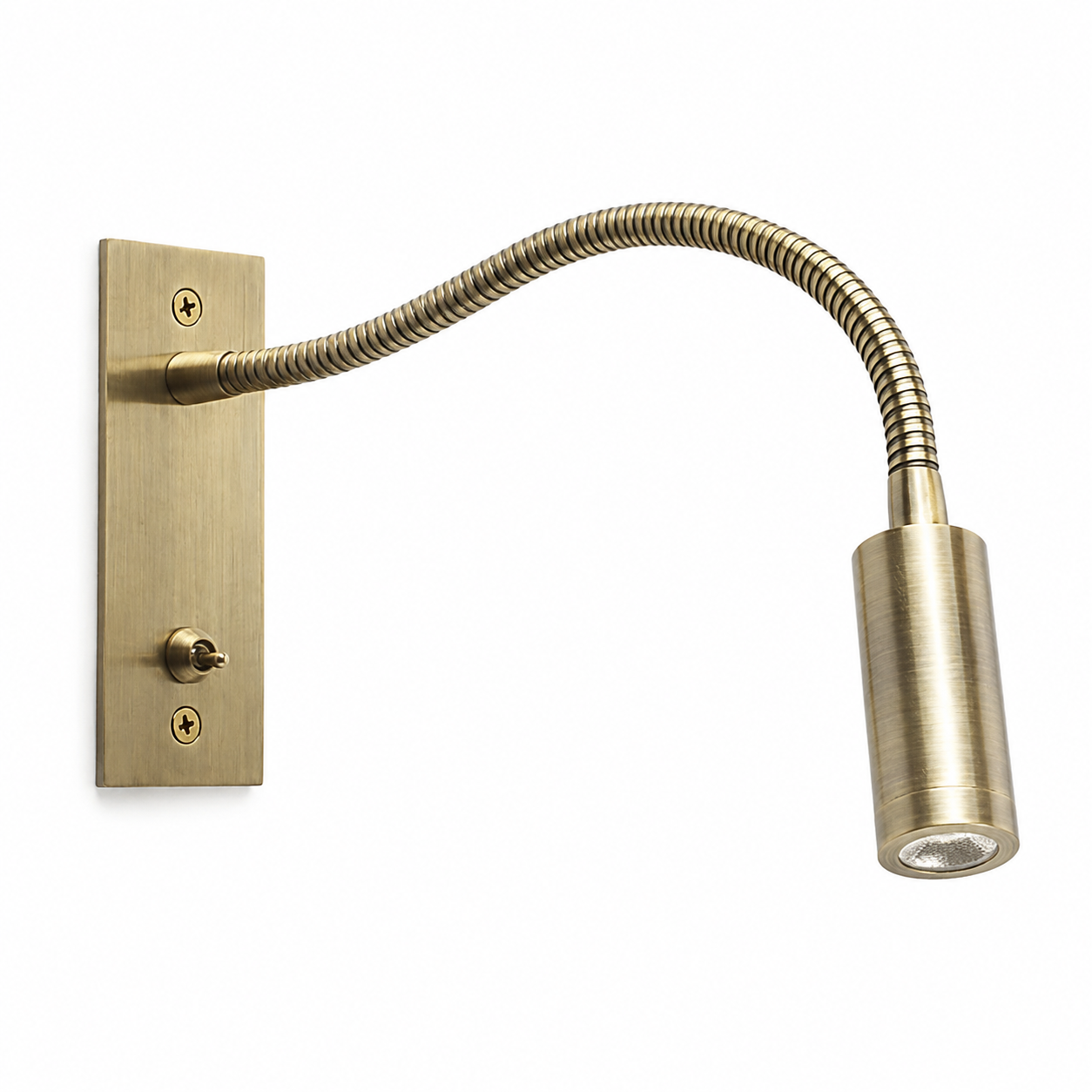
MD-WL-Y092 has a documented flexible 3 W head and touch dimming, with a toggle. The exact control sequence remains to be checked on the ordered sample. Nothing in that product fact pack establishes a spectral or sleep outcome. Do not label it “blue-light free” without a suitable measured spectrum. Aim and shield the actual head so a guest can use it at a comfortable setting.
Test the complete evening scene
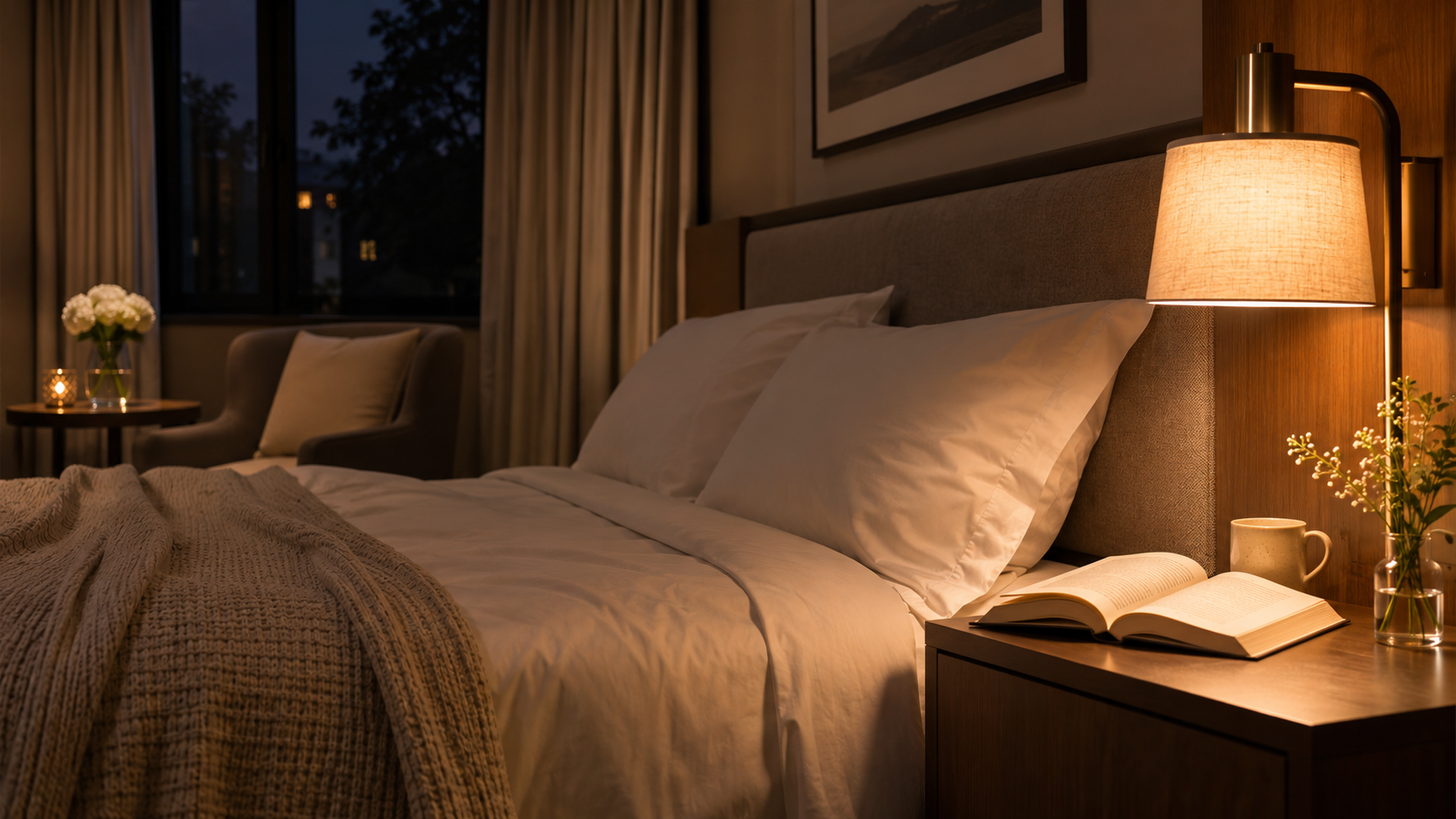
Run the room after dark with curtains in place. Start from the arrival scene, read on one pillow, then move to the night setting. Observe visible source brightness, reflections in mirrors and glossy finishes, neighboring-pillow spill and the floor route. Ask whether the controls can be operated without turning on a bright ceiling layer. Record the exact fixture, driver, dimmer and scene settings used in the test.
Do not assume that lowering a dimmer always makes light warmer, or that selecting a warm-white factory option enables guest-controlled colour changing. Those are separate product features. The warm-white bedroom guide explains how to compare appearance and colour options. Where a lighting designer specifies spectral metrics, request a report for the complete ordered configuration at relevant output states.
Write a careful procurement brief
State the desired guest actions, maximum visible source intrusion, dimming range if needed, and control relationship to master-off. Ask for the exact CCT option, full luminaire data and, when relevant, spectral measurements. Keep the approved physical sample and scene matrix together. Avoid medical, sleep-quality or wellness promises in the public schedule unless independently substantiated for the actual use case. A comfortable, legible room is an observable project goal; a personal biological result is not.