
Quick answer
Start with a serviceable assembly, correct installation and approved cleaning, then use fault records to catch repeated failures early.
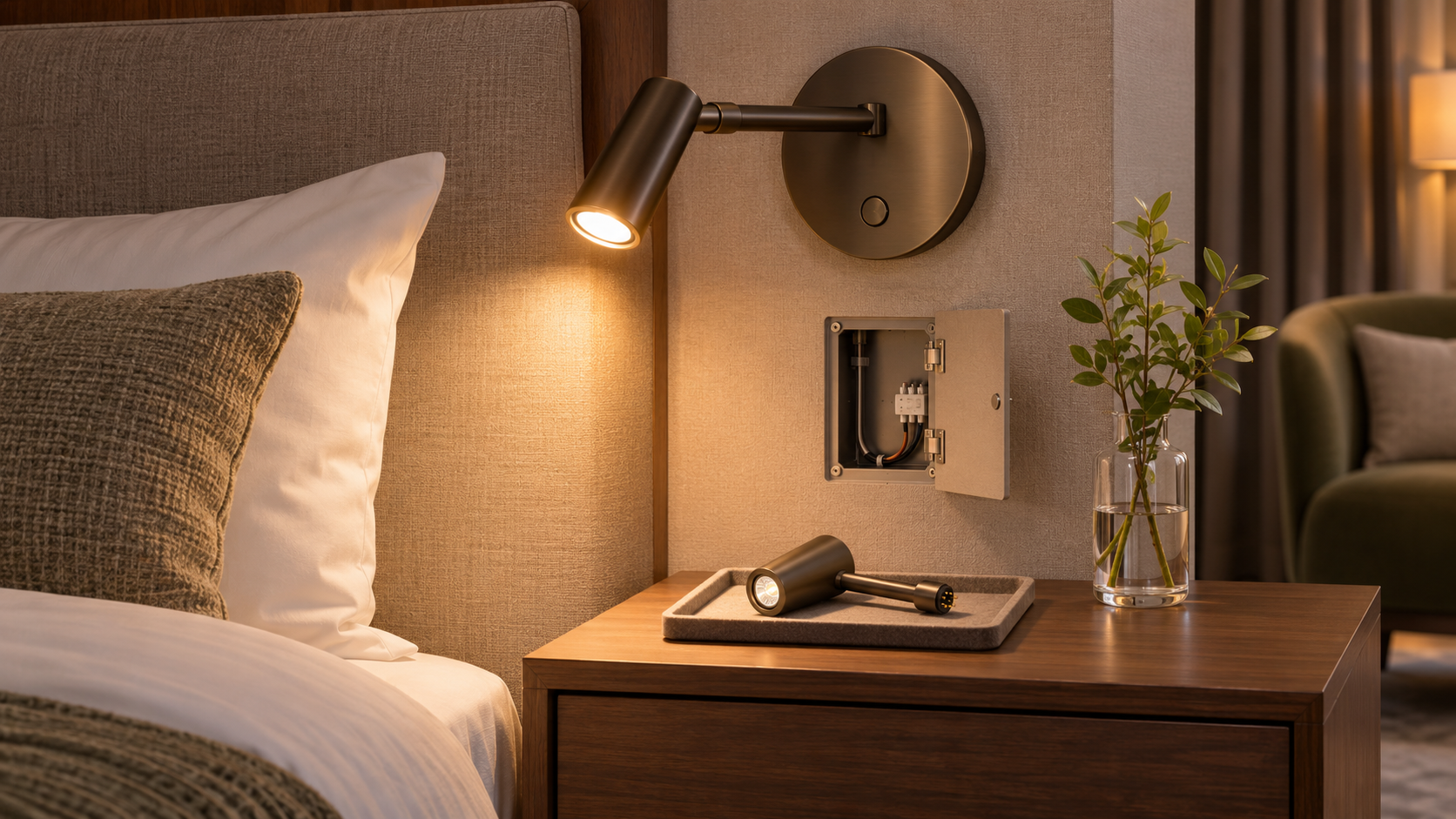
To extend the service life of hotel bedside lights, specify a serviceable assembly, install it correctly, clean it by the manufacturer's method and act on early fault patterns. An LED source may operate for a long period while a driver, switch, flexible arm, USB module or finish needs attention sooner. A catalogue lifetime number does not prove the complete luminaire will remain usable in every room. The hotel should keep exact model records, train staff to report damage and use approved replacement parts. Any electrical repair belongs to qualified personnel under local rules.
Choose for the way guests use the light
Observe the tasks before procurement: reading from a pillow, aiming a flexible head, switching in darkness and charging a phone if the fitting includes a port. A head that is repeatedly forced beyond its comfortable range may wear early. A switch behind a pillow may be struck during bed-making. Change the position or model in the mock-up rather than asking maintenance to manage a design conflict indefinitely.
Ask for product-specific information about moving joints, finish care, driver access and replacement parts. The durability guide provides a selection framework, while this page concentrates on operating practice after installation.
Protect the installation
Use the current manufacturer's fixing and electrical instructions. A secure backplate, protected cable path, suitable supply and accessible driver matter to reliability. Confirm the headboard or wall substrate before repeat installation. If the room's control system has dimming, verify compatibility with the exact driver and operating sequence. A wrong dimmer or improvised wiring can cause symptoms that appear to be luminaire failure.
Record the approved position, model and component revision in the as-built room schedule. Later changes to mattress, headboard or table can alter how guests touch or aim the light. Recheck the assembly after a furniture renovation.
Clean and inspect without introducing damage
Housekeeping needs the approved method for shade, metal finish, diffuser and port. Do not spray liquids into a fitting or use abrasive polish on a coated surface. Train staff to report a loose arm, damaged cable, discoloured shade or flicker rather than tightening or cleaning it away. A qualified maintenance worker can then assess the fault safely. The metal-finish care guide and fabric-shade care guide separate those materials.
Inspect the fittings during planned room maintenance, using manufacturer guidance and site risk assessment for frequency. Check whether both sides of a bed still match in appearance and colour. A replacement with a different optic or CCT may work electrically but reduce the room's visual consistency.
Learn from work orders
Log each symptom, location, component, service action and time out of use. Group recurring issues by model and production lot. A cluster of driver faults, worn switches or failed chargers deserves investigation with the supplier and electrical designer. Repeatedly replacing the same part without identifying the cause may shorten the useful life of the entire installation.
Keep compatible spares and a controlled substitution procedure. The spare-parts guide explains how to link later repairs to the original specification. Ask the supplier what it can document about future availability; do not convert an informal statement into a guarantee.
Service life improves when design, installation and care are treated as one system. The practical measure is a light that continues to meet the guest task and can be restored safely, not merely an LED that still emits some light.