
Quick answer
Compare service access, replaceable parts, fault isolation, cleaning labour and guest-room downtime alongside purchase price.
To reduce hotel lighting maintenance costs, map the work required to clean, diagnose and repair each fitting before choosing it. The purchase price of a luminaire is only one part of a hotel's operating cost; guest-room access, labour, replacement parts, finish damage and downtime also matter. A long LED life claim does not describe driver, switch, charger or optical failures. Start with a room-level maintenance plan and a representative fitted sample. Use actual supplier documents and site records for any cost forecast, rather than assuming a universal saving percentage.
Count the work, not just the lamps
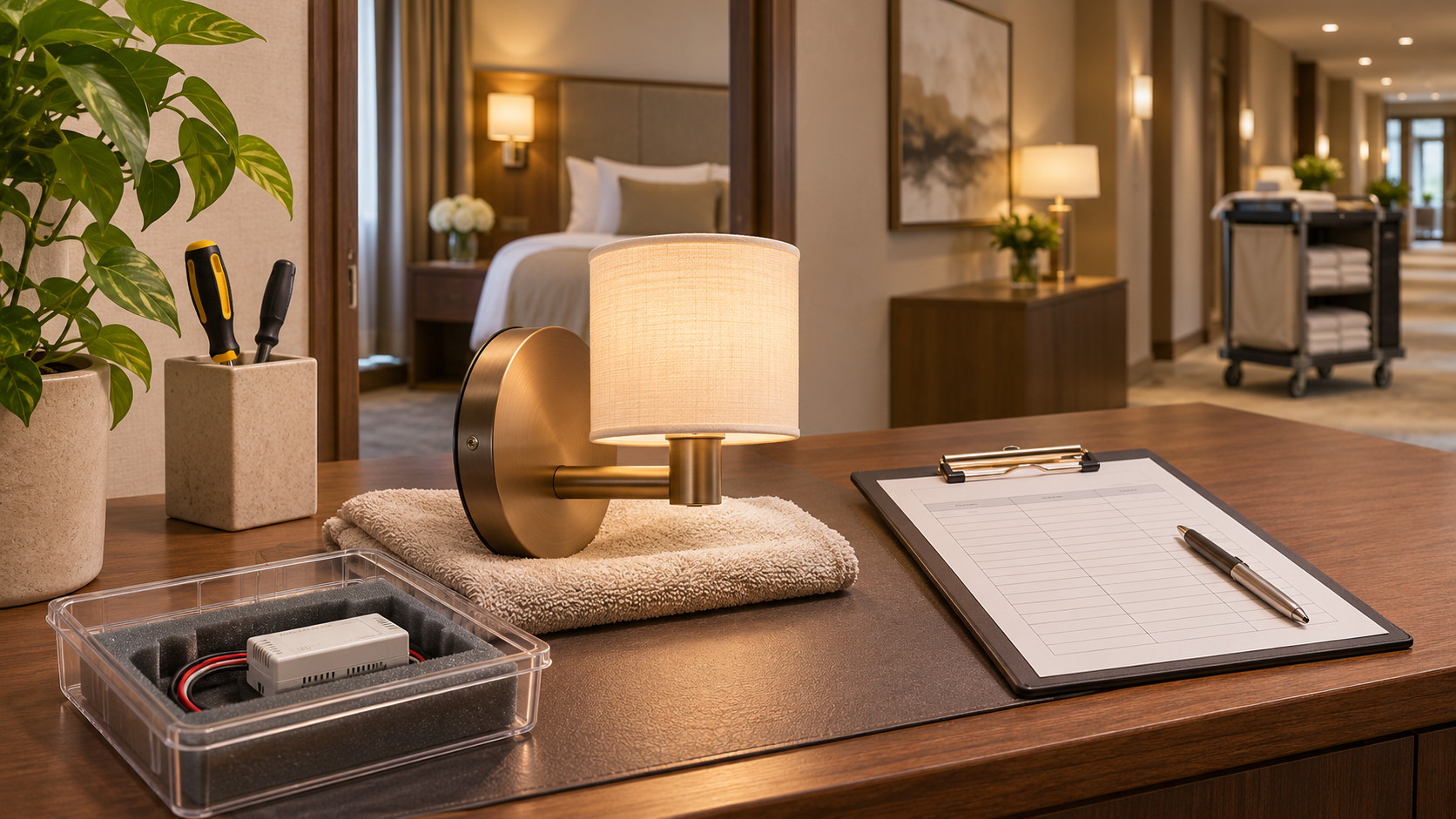
List the fittings in a typical room and the actions maintenance staff may perform: cleaning a shade, testing a switch, replacing a driver, checking a loose arm and restoring a damaged finish. Note which actions require a room to be taken out of service and which need a qualified electrician. A fitting behind permanent joinery can be expensive to reach even if the component itself is inexpensive. Compare candidate assemblies on access, not simply on stated LED hours.
The US Department of Energy's luminaire lifetime guidance describes the difference between LED-source maintenance and whole-system failure. It is general background, not a test report for any MYDE model. The contract-grade explainer helps turn a broad durability label into checkable requirements.
Build service access into the room
Ask where the driver, connections and replaceable module sit. Can a technician remove the luminaire without stripping the headboard or damaging wallpaper? Are fasteners accessible after the bed and side table are installed? Can the light be isolated safely? The manufacturer's current instructions and local electrical rules control the actual procedure. A decorative backplate that hides a large hole may still be difficult to replace later if a successor product has a different footprint.
Choose finishes and shades with cleaning in mind. Ask for a product-specific care method and test it on a sample with the hotel's actual approved cleaner. Unverified chemicals can damage a coating or fabric. Frequent cleaning should be possible without changing the aim of a reading head or loosening its switch.
Use a controlled spare strategy
Record exact model and option codes, driver and control compatibility, finish reference, and room locations. Keep an agreed quantity of the parts that are actually serviceable, based on supplier availability and observed failure patterns. Do not buy a generic driver because the connector appears to fit; electrical characteristics and approvals must match. The spare-parts planning guide sets out the inventory decision.
When a fitting fails, log symptom, room, component, age, cause where known, repair time and parts used. This creates a local evidence base for changing the specification. A high count of repeated switch failures may justify a design review; it should not be hidden by replacing only the visible part.
Compare options through a test room
Install each shortlist candidate, then ask a maintenance technician to perform a safe simulated removal and cleaning review. Time the access and document any finish damage or special tool requirement. Have a guest-use reviewer check that serviceability changes do not compromise visual comfort or controls. Revisit the plan after the first operating period with real work-order data.
A credible cost reduction comes from fewer avoidable failures and simpler approved service. It cannot be guaranteed by a catalogue lifetime number alone.