Quick answer
Define which guest devices must charge, then verify the exact port's voltage, current, protocol and behavior under simultaneous use.
The hotel bedside USB charging wattage guide starts with the devices the room must support. A phone, tablet and laptop can have very different charging requirements, and a connector shape does not state the delivered power. Ask the operator which devices guests are expected to charge, how many may be connected at once and whether overnight maintenance or fast charging is the objective. Then verify the exact port's voltage, current, protocol, shared-load behavior and destination-market electrical approval. Do not select by a USB symbol or a lifestyle photograph.
Write a device brief before a watt figure
List the expected devices and cable types. Decide whether the room must simply maintain a phone overnight or support more demanding devices. Check whether guests also need a conventional power outlet. A higher advertised wattage has little value if the device, cable and port do not negotiate the relevant mode.
USB-IF's Type-C product language guidance distinguishes the USB-C connector from USB Power Delivery. Power capability varies between products. The USB-C requirements guide handles that broader protocol brief. This article focuses on checking usable power at the bedside.
Read the output label correctly
For each port, request rated voltage and current for every supported mode, not only one maximum watt number. Ask if two ports share a power budget and what happens when both are used. Confirm whether the output remains available when the room master is off, if that is part of the guest brief.
The documented MD-WL-Y003 has one USB-A port rated 5 V/2 A. Multiplying those values gives a nominal 10 W output rating for that port; it does not establish charging speed for a particular phone or support for USB-C, Power Delivery or a laptop. If a procurement brief requires any of those, request another exact documented configuration rather than relabeling Y003.
Test with representative devices
Charge a representative phone and tablet using known compatible cables. Observe the behavior with one device and with the maximum intended simultaneous load. Check connector access with the actual bedside table, headboard and mattress in place. A correctly rated outlet can still be awkward if a short cable must cross the pillow.
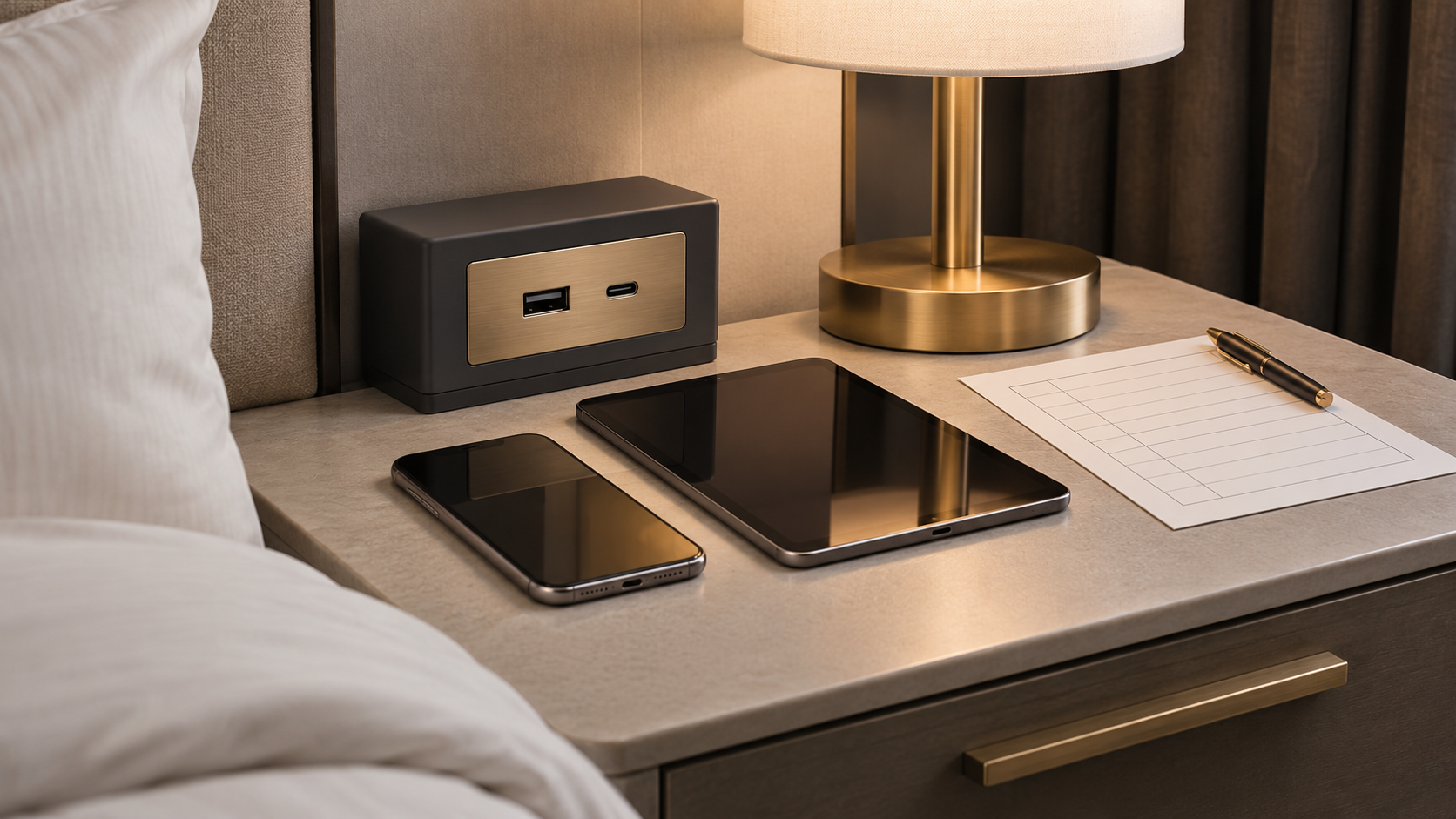
Ask the electrical team to check supply, protection and local approvals for the installed unit. Charging electronics and a reading light in one faceplate remain separate functions for specification and maintenance. A USB port shown on an AI illustration is not product evidence.
Keep a versioned acceptance record
Record the approved module, output table, supported protocols, port count, test devices, cable assumptions and behavior after room-master changes. If the supplier proposes a different charger board later, repeat the device and shared-load checks. Port labels should reflect the delivered capability, not the originally proposed one.
The practical outcome is a charging service that matches the hotel's stated device brief and remains easy to reach and maintain. A generic wattage target from another project cannot replace the exact device, port and room test.