
Quick answer
Treat contract grade as a prompt to verify construction, complete-product evidence, cleaning and repair.
What does contract grade lighting mean? In hotel procurement it usually signals that a luminaire is intended for repeated use in a commercial project, but the phrase by itself is not a certification, test method or guaranteed service life. Translate it into verifiable requirements for the exact product: electrical suitability, mechanical construction, finish care, service access, consistent supply and documentation. Ask which evidence supports each claim. A fitting can be marketed as contract grade while still requiring a project-specific check of mounting, controls and destination-market approval.
Replace the label with a performance brief
Start with the location and likely wear. A bedside reading head is handled and adjusted; a corridor wall light may be cleaned frequently; a bathroom fitting faces a different environment. Define how guests and staff will touch it, which surfaces require cleaning, and whether a damaged component can be replaced without removing finished joinery. These conditions shape the assessment more than the marketing label.
Request a dimensioned drawing, material and finish specification, electrical data, installation instructions, service information and evidence relevant to the intended jurisdiction. Ask whether the supplier's claims apply to the complete luminaire, not just its LED board. The durability guide gives a wider test-and-maintenance framework.
Judge the installed assembly
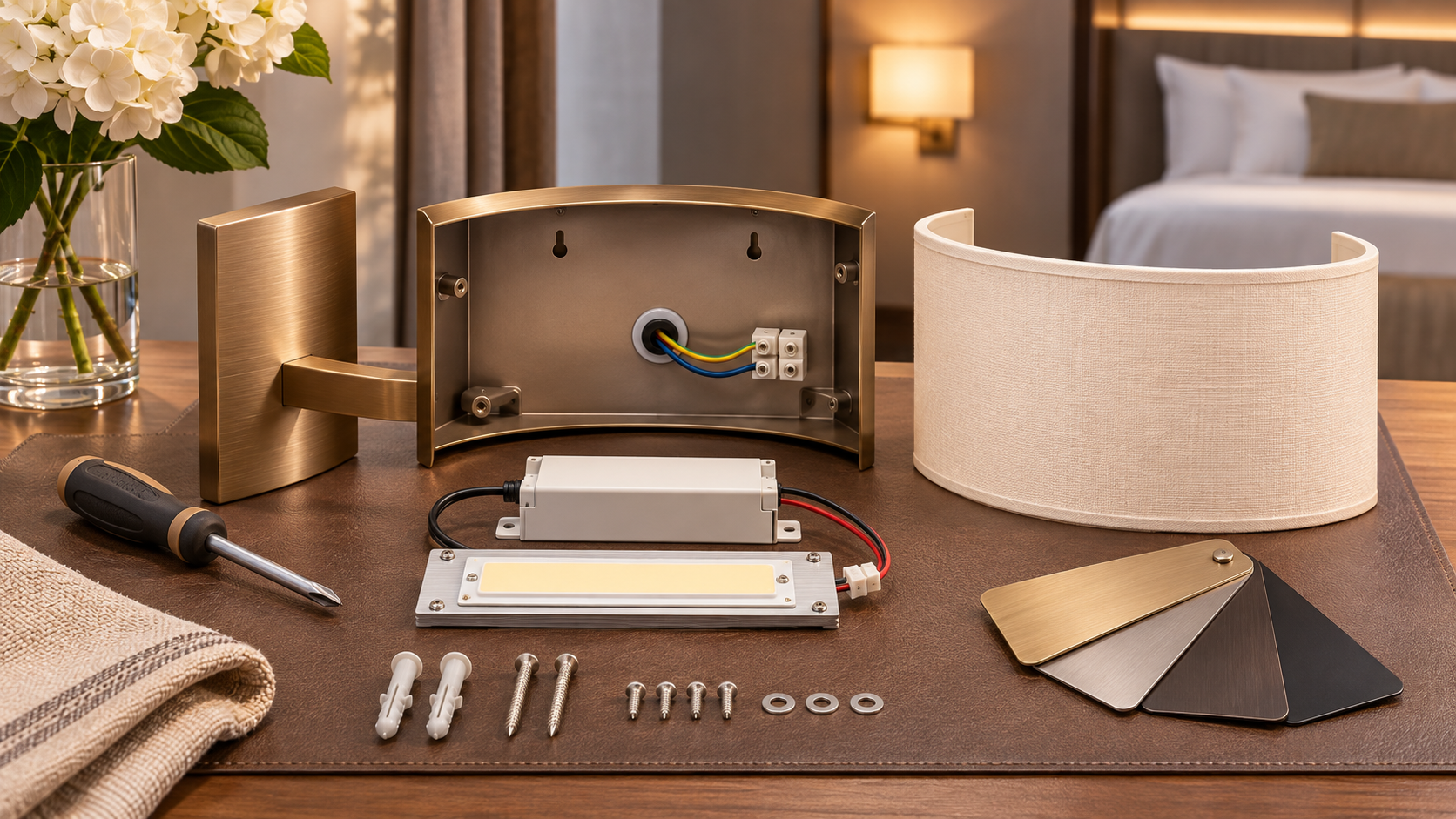
The fixing, wall substrate, cable connection and access panel are part of the practical outcome. A robust housing attached to weak joinery can still loosen. A long-lived LED source is of limited use if a failed driver is sealed behind a permanent headboard. Review the actual installation detail with a qualified team and build one representative room. Operate adjustable heads, switches and ports repeatedly in normal guest positions. Check whether a fixture can be removed and refitted without damaging the finish.
For finishes, ask for a physical reference, approved cleaning method and any stated test basis. Do not assume that a visible coating resists every chemical used by housekeeping. Examine exposed edges and joints where dirt or moisture can accumulate. If different project phases need a colour match, retain a signed reference sample and require a controlled substitution process.
Check technical claims carefully
If a supplier quotes lifetime, ask what was tested: LED package, module, driver or whole fitting, at which conditions and failure criteria. If a claim concerns ingress protection or impact resistance, request the exact rating and test report for the ordered model. A component certification does not automatically cover a luminaire assembled with a charger or receptacle. Have the project electrical designer review safety evidence for the destination.
The US Department of Energy's luminaire lifetime guidance explains why LED systems have multiple possible failure modes. It is background evidence, not a MYDE test report. No documented MYDE bedside model should be described as holding a particular contract-grade certification solely because it is proposed for hotels.
Ask about repeat supply and repair
Hotels replace damaged lights over years, sometimes after a renovation has changed the furniture. Ask how long key components are expected to remain available, how replacements are identified and how finish changes are communicated. Do not turn a supplier's informal estimate into a guaranteed availability period. Agree what happens if a driver, LED module or finish is discontinued. A practical spare strategy may matter as much as an initial test result.
Build a record with the exact model code, approved options, sample revision, drawings, cleaning method and replacement parts. Share it with procurement and facilities teams. The contract-grade claim then becomes a list of specific obligations the buyer can evaluate and maintain.
Buyer questions
- Which complete-product evidence applies to this variant and country?
- How is the unit fixed, operated, cleaned and repaired in the built room?
- What does the lifetime statement cover and exclude?
- Can later batches be compared with a retained finish and optical sample?
- Who approves a substituted component before shipment?
Use the answers to decide suitability; do not use the label as a shortcut.