Quick answer
Test the fitting from the reader's eyes and the neighboring pillow. Aim useful light at the page while keeping the source out of direct view. Check reflections, spill, shielding and control settings in the actual room geometry.
To avoid glare from bedside reading lights, test the fitting from two eye positions before approving it: the person reading and the person on the neighboring pillow. Aim useful light at the page while keeping the bright source out of direct view. Adjust mounting position, head direction, and shielding together. A narrow beam can reduce spill, but its stated angle does not prove comfort. The final check belongs in a room mock-up with the actual mattress, pillows, headboard, finishes, and control setting.
Identify the kind of glare you are seeing
Direct glare occurs when a bright source or lens is visible in the normal field of view. Reflected glare appears as a bright image on a tablet, glossy book page, polished bedside table, mirror, or headboard trim. Spill is light that reaches the adjacent pillow or room when the reader only needs the page. These problems can occur together, but each calls for a different correction.
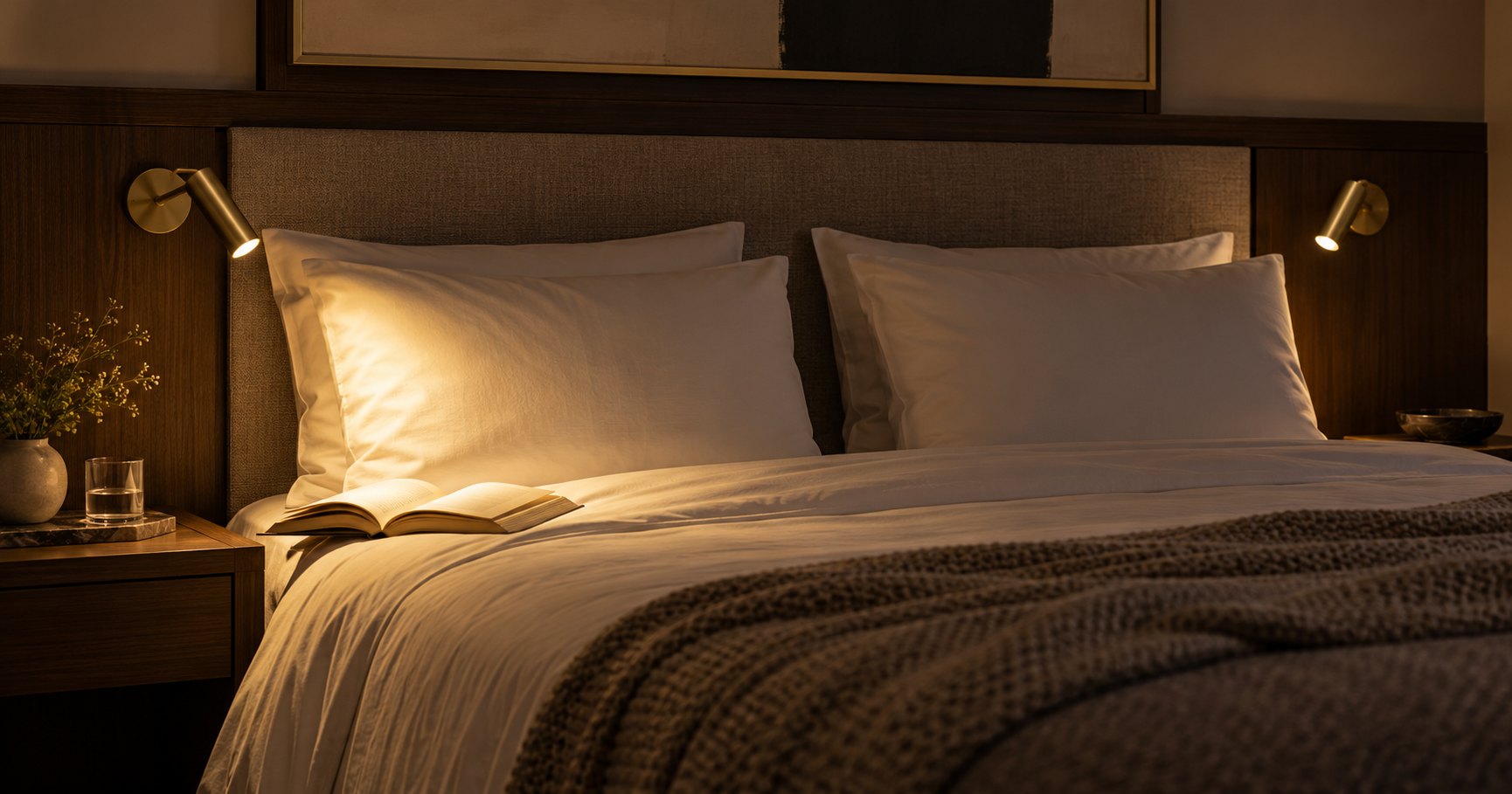
Do not rely on a standing view of a headboard. Recline as a guest would, look toward the candidate, and check the neighboring pillow. Repeat when the head is aimed at the book and when it is parked. A fitting that looks discreet when off can become uncomfortable in use.
Start with position and aiming
Mark the reader's expected eye line, book plane, and the light's mounting center on an elevation. Install a sample temporarily. Aim the head so its useful beam reaches the page without crossing a face. Check upright and reclined positions; the book moves with the guest, and a single fixed test point may hide a poor placement.
Move the candidate or change its angle if the source remains visible. If the room has two beds or pillows, repeat the exercise from each occupied side. Independent controls help one guest read without making the whole room bright, but they cannot fix a beam aimed into the neighboring eye.
Understand what a beam angle can and cannot tell you
The Illuminating Engineering Society defines beam angle at the directions where intensity falls to half the beam maximum. Light still exists outside that angle. The number also does not describe the source's apparent brightness to a seated guest, the field angle, or the light on a book at a particular distance.
Ask for photometric data for the exact fitting and optic. Compare candidates at the same mounting position and page plane, then check them in the mock-up. A smaller angle may concentrate light on the task but produce a more noticeable bright patch; a wider one can wash the neighboring pillow. Neither is automatically better.
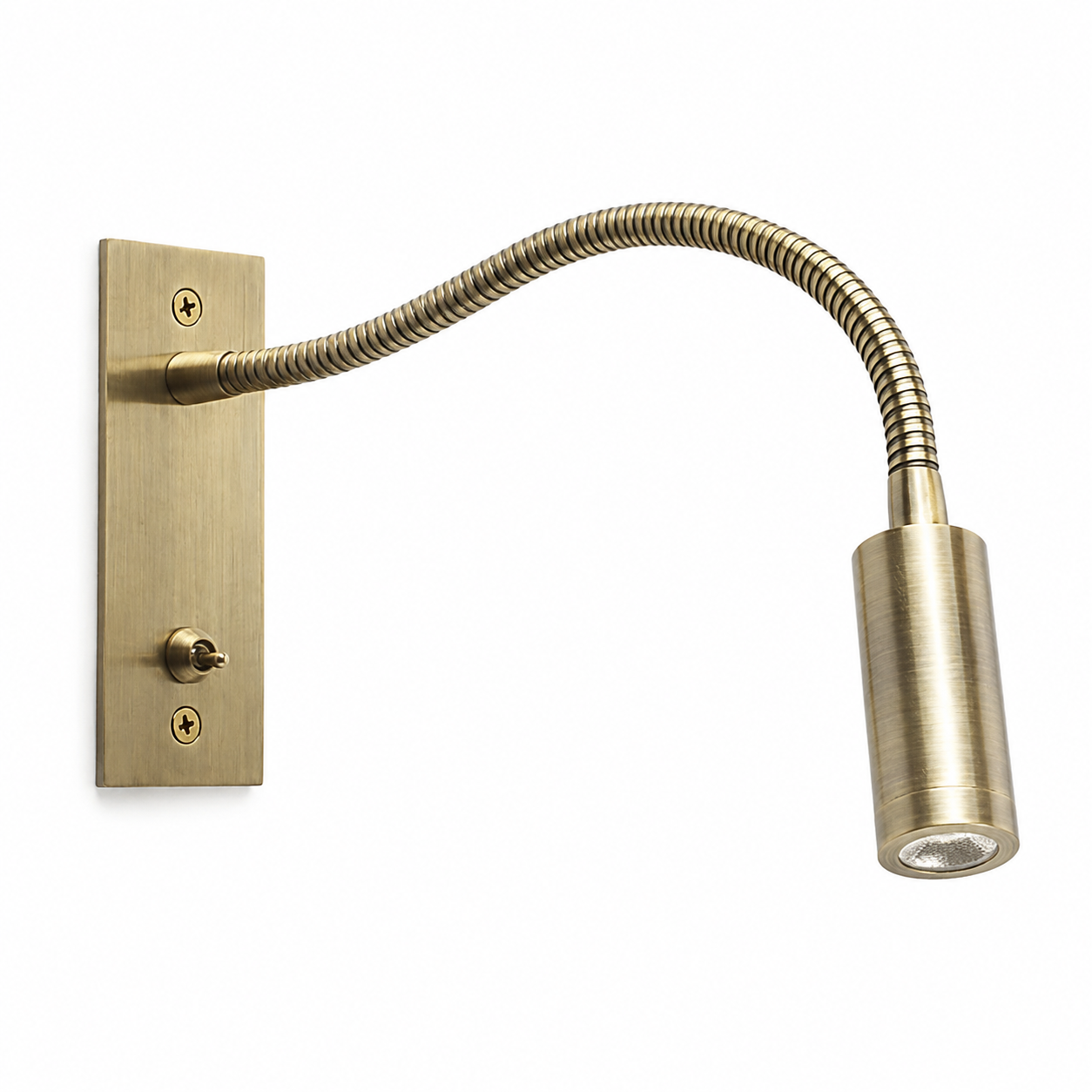
MYDE MD-WL-Y135 and MD-WL-Y003 each have a documented 30° beam for their specified reading heads. That is a model-specific starting point for testing, not a promise of low glare in every headboard. Their adjustable heads still need to be aimed and viewed from the real bed.
Review shielding and nearby surfaces
Look for a recessed lens, baffle, shade, or other shielding that hides the source at the relevant view angles. Check the real component; a dark housing in a product render is not evidence of a particular optical design. Request a cross-section or physical sample when shielding is central to the selection.
Test reflections with the intended finishes. A metallic headboard detail or glossy bedside surface can return a bright image toward a guest even when the source itself is hidden. Move the luminaire, change the surface, or adjust the optical direction as needed. Photograph the before and after positions so the correction reaches the installation team.
Test at the settings guests will use
Check the reading light with ambient lighting on and off. A source that seems mild in a bright mock-up can feel intrusive in a dark room. If dimming is specified, test the lowest usable setting and the off state with the real driver and control. Do not assume every model dims: MD-WL-Y003 is documented as non-dimmable, while MD-WL-Y092 has touch dimming and a toggle whose exact interaction still requires sample review.
Include a simple night-use check. Can a guest find and turn off the reading light without looking directly into it? Does a master switch unexpectedly restore it at a bright setting? These are control and room-system questions, not solely luminaire questions.
Record an approval criterion
Ask the project lighting designer to define any numerical target and measurement method. Then document the human checks: page readable in the intended posture, source not conspicuous to either guest, limited spill to the neighboring pillow, no distracting reflection, and acceptable control behavior. Record the exact model, optic, mounting coordinates, finish, and approved aiming position. If any of those change, repeat the glare check.