Quick answer
Check the design from the guest's position. Verify task light, glare from both pillows, control behavior, colour samples, installation drawings, charging and service access before approving a repeated room package.
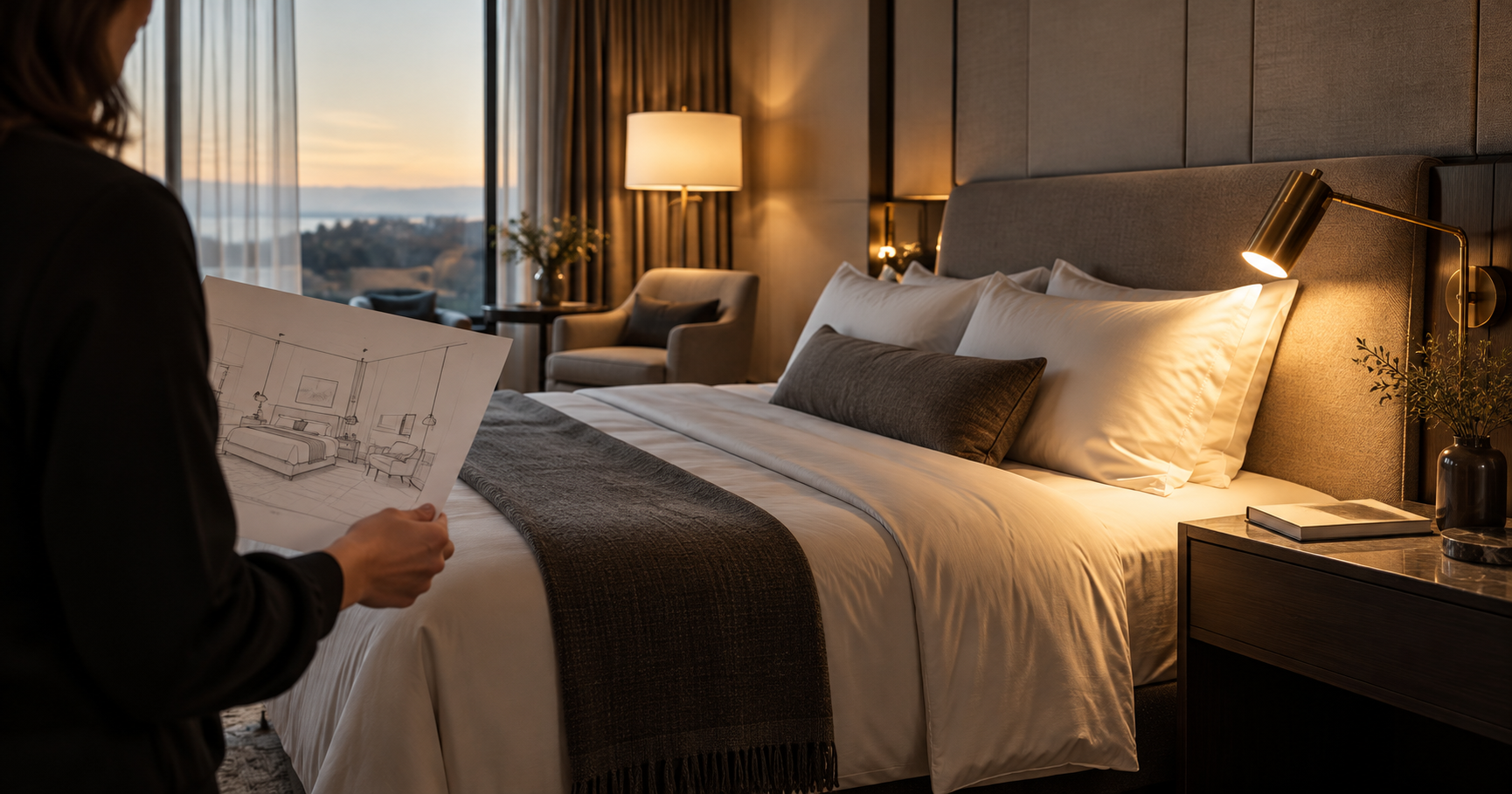
The hotel lighting design mistakes to avoid are easiest to catch in a full-size guestroom mock-up. A scheme can look balanced on a reflected ceiling plan while a guest sees a bare light source from the pillow, cannot find the off switch, or has a dark page beside a bright headboard. Review each lighting decision from the guest's position and check the fitting, control, wiring, and maintenance route as one system. The points below turn common drawing-stage omissions into checks a design and procurement team can perform before a repeated room package is ordered.
Mistake 1: treating room brightness as task lighting
A broad ceiling or decorative source may make the room appear bright in a photograph while leaving the reading plane or desk in shadow. Give each activity a clear light source. Mark the actual book, work surface, mirror, and luggage position on the plan. Test them with a person in place; a photometric calculation alone cannot show whether the user shades the task with their own body.
Do not assume every task requires another fixture. A well-placed source may serve more than one activity. The test is whether it does so comfortably in the real geometry, with the guest controls available.
Mistake 2: checking glare from the drawing only
The view from a reclining guest is different from the designer's view at standing height. Sit at both pillows. Aim each reading light at the expected page and look toward the fitting from the reader and neighboring position. Check exposed sources, reflections in glossy surfaces, and spill across the bed. Move or shield the candidate before approving it.
A nominally narrow beam is not an automatic glare solution. Beam angle describes part of the distribution; the visible source, mounting height, and aiming direction still matter. The Illuminating Engineering Society beam-angle definition measures the angle between half-maximum intensity directions, not a boundary beyond which no light exists.
Mistake 3: specifying a control behavior the product cannot provide
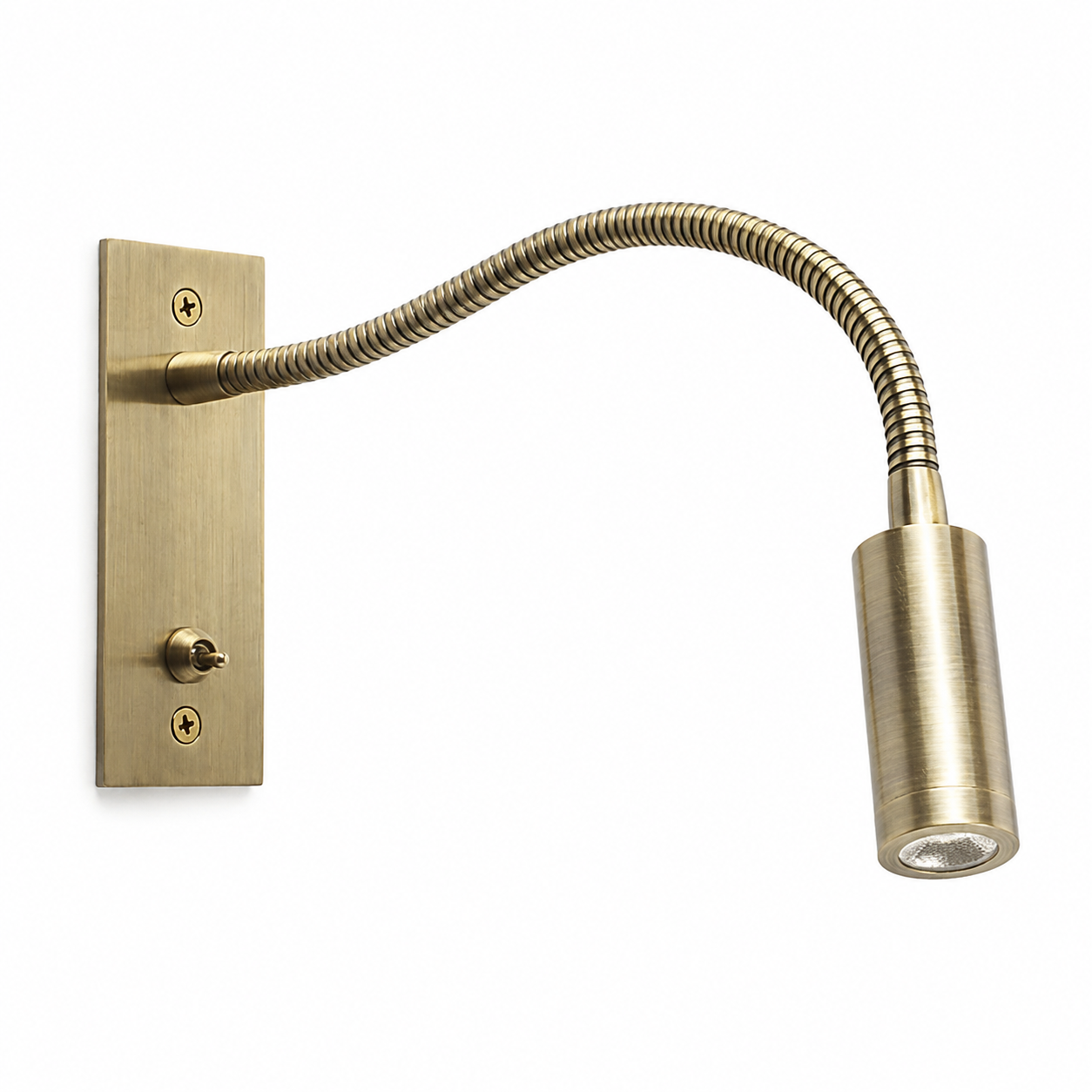
List every action a guest needs: switch on at entry, read on one side, dim or turn off near the pillow, and move at night. Then verify the exact fixture and control circuit. A request for dimming does not make a non-dimmable light compatible. MYDE MD-WL-Y003, for example, has a physical toggle and is specified as non-dimmable. MD-WL-Y092 has touch dimming and a toggle, but their interaction still needs a sample check.
Test master-switch and room-control behavior with the actual driver and wiring plan. A control sequence that requires a guest to operate several unexplained switches should be revised before it is repeated across rooms.
Mistake 4: copying colour values without comparing samples
Colour temperature is a design choice tied to finishes and adjacent sources. Look at the intended lamp and room materials together under evening conditions. Compare bedside, ambient, desk, and mirror lighting. The US Department of Energy notes that CCT compresses a complex colour appearance into one number and that CRI has limitations. The numbers are useful specifications, but a signed physical sample remains valuable.
If a product has selectable factory CCTs, name the ordered configuration. MYDE MD-WL-Y135 lists 2700 K, 3000 K, and 4000 K as options. This does not mean a guest can change CCT in the room. Record the chosen option in the purchase schedule.
Mistake 5: releasing joinery from a product photo
The visible faceplate is not a cut-out or wiring diagram. Before a headboard is built, request the exact mounting drawing, recess depth or backplate, fixing method, cable entry, driver position, and replacement access. Compare those with the joinery section and electrical drawing. For renovation work, open a representative room and verify the wall build-up instead of assuming every room matches the original plans.
The Y135 source pack gives an overall size of 168 × 68 × 52 mm but leaves the cut-out and dimension axes unconfirmed. Using those figures as a joinery opening would turn an acknowledged gap into an installation error.
Mistake 6: merging charging and lighting into one vague item
If charging is needed, give the connector, rated output, supply arrangement, and market documentation their own specification line. The light switch and port may have different power behavior. Test whether charging remains available when the guest turns off a reading light or room master switch, according to the agreed design.
For example, Y003 has one documented USB-A port rated 5 V/2 A. Its presence does not prove USB-C, Power Delivery, or a receptacle. Ask for the exact product record rather than inferring functions from a similar-looking model.
Mistake 7: approving appearance without a service plan
Hotel fittings are installed repeatedly. Confirm how a failed driver, switch, light head, or shade is identified and replaced without damaging the finished headboard. Establish spare-part names and the documents maintenance staff will receive. Ask who supplies any separately ordered lamp or driver.
Make a signed mock-up record for each room type. Include the exact model configuration, finish chip, control sequence, installation drawing revision, photographs, and open issues. A visual approval with unresolved electrical or service questions is incomplete. The goal is a room that remains usable after installation, not simply one that looks right at handover.