Quick answer
Treat both sides of a king bed as separate reading positions, then test aim and controls from each pillow before fixing the mounting points.
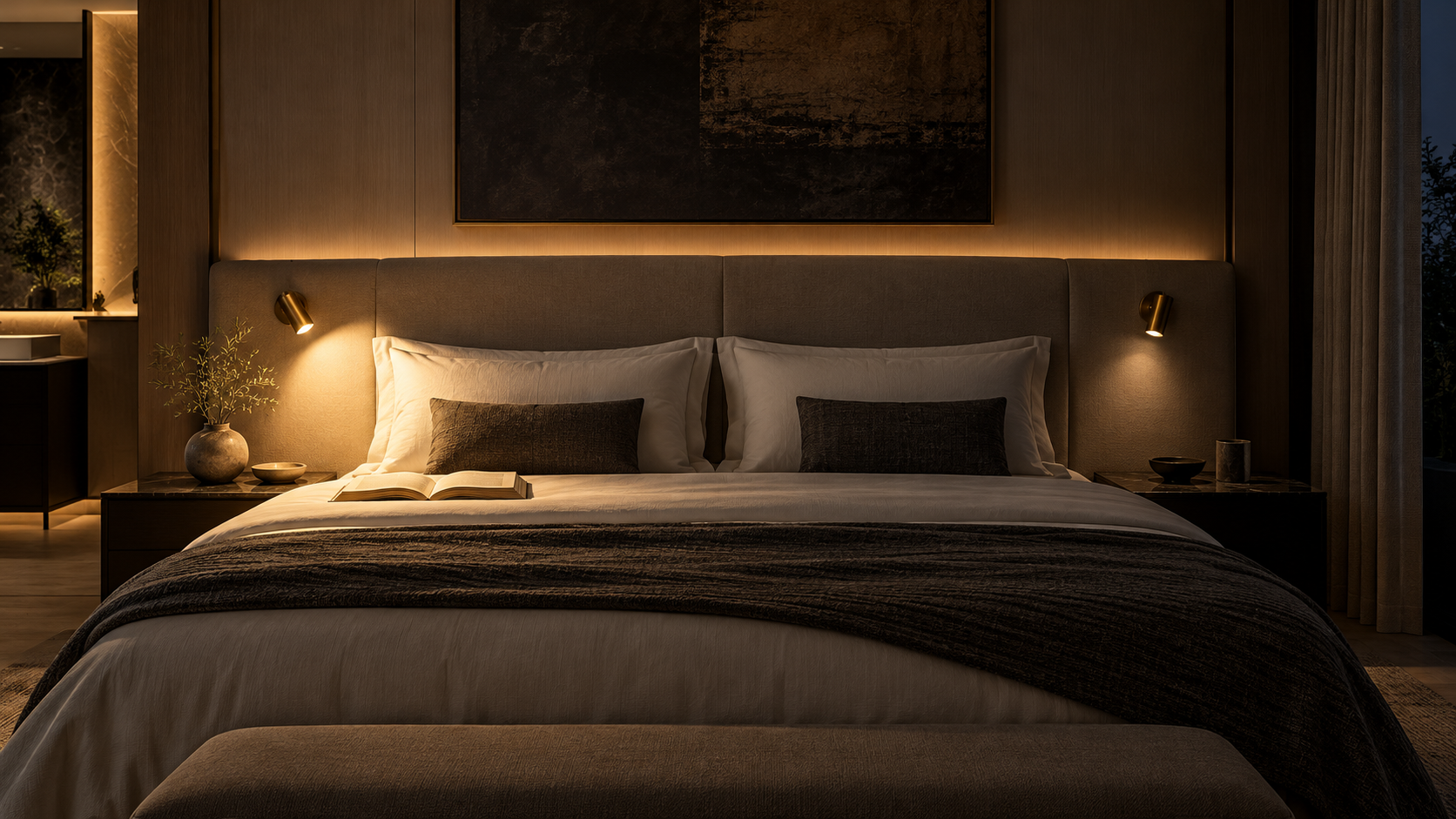
To design lighting for a king hotel bed, treat the two sleeping positions as separate guest tasks within one shared composition. Mark where each person sits and reads, where the pillows end, and how both guests reach a switch. Provide independent reading light when both sides need it, then test whether one person can use a book without exposing the other to the source or spill. Symmetry on an elevation is useful, but comfort, reach and the actual headboard geometry decide the mounting points.
Draw two reading positions
The center of a king bed is not the center of either reader. Place two seated positions on the drawing using the final mattress, pillow and headboard. Mark the likely book positions and eye lines. If the bed or bedside tables are offset by a wall or window, record the actual usable side space rather than forcing mirrored coordinates.
Check whether each guest can aim the reading head and reach its control without leaning across the other person. Test upright and reclined postures. The bedside reading-light selection guide describes the broader fitting decision; this page concentrates on the two-person layout.
Control spill between pillows
Set up the intended fixture on one side and observe from the other. Look for a visible LED source and light falling across the second pillow. Adjust mounting, shielding and aim until the chosen product works at the actual distance. A quoted beam angle alone does not prove that the neighboring guest will remain undisturbed; the headboard finish and pillow positions also affect the result.
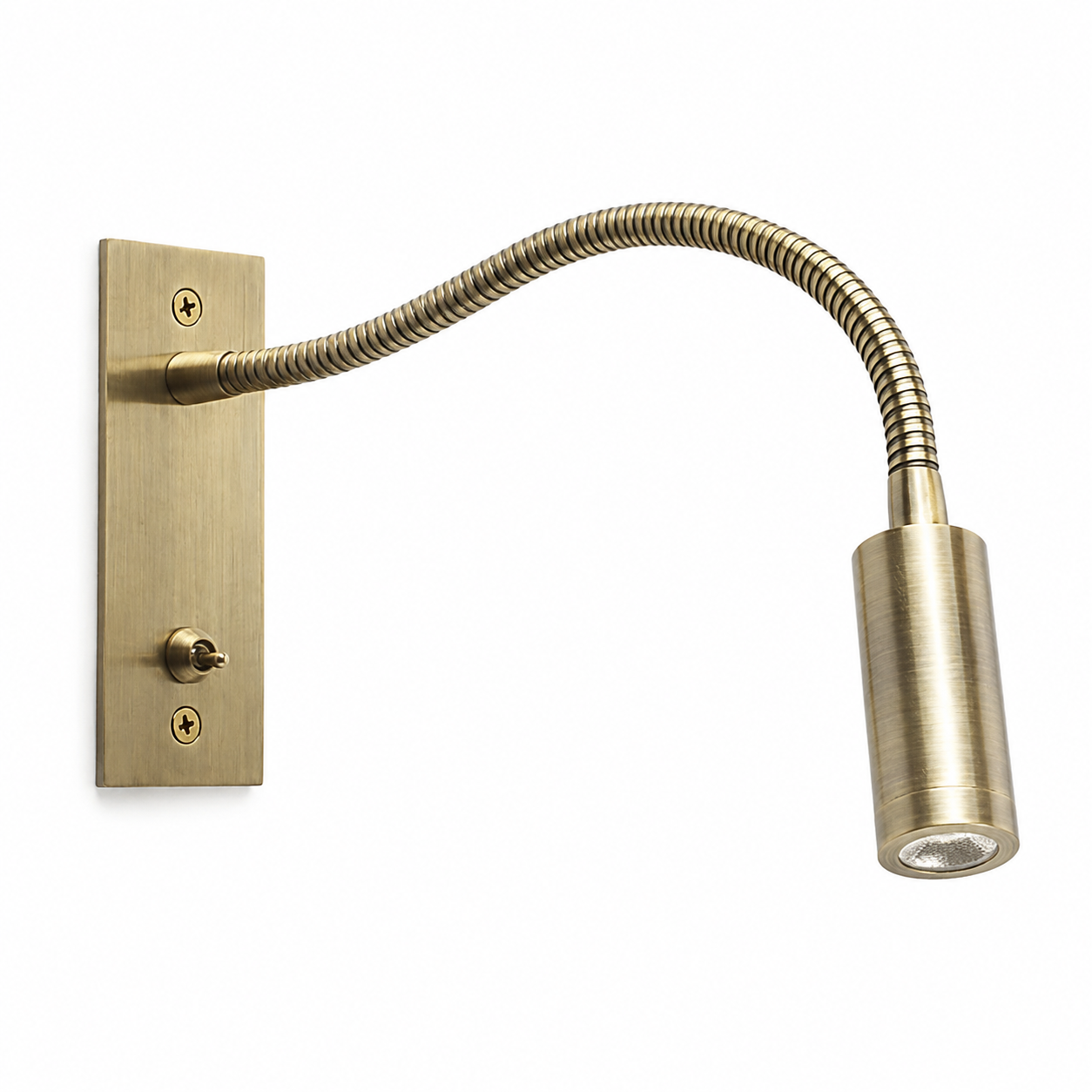
For a recessed direction, the documented MD-WL-Y135 has an adjustable 3 W reading head. Its 30° beam is model-specific and does not establish a finished-room result. For a flexible direction, MD-WL-Y092 has a movable arm and touch dimming. Check its parked position so it does not project awkwardly beside the pillow. Verify the exact control sequence on a sample.
Decide what is shared
Ambient, decorative and night-route light may be shared across the bed; focused reading control should be considered separately for each guest. Document what the entry switch, master switch and each bedside switch do. If a wall-light assembly includes charging, verify that the guest on each side can reach a suitable port and that switching off the light does not unintentionally remove intended charging power.
Do not use one switch panel's appearance as proof of its behavior. Test a person unfamiliar with the room: can they turn on their own light, turn off shared light, and leave the bed safely? Record the sequence and any labels needed.
Approve the real headboard
Build or mark a full-scale headboard with actual upholstery thickness, bed height and side-table clearance. Check fixing substrate, access, cable route and cut-out or backplate dimensions from verified product drawings. A fixture's overall dimensions are not a cut-out specification.
Photograph the accepted locations and aim from both pillows. If the bed width, mattress thickness or headboard design changes between room types, repeat the two-person test. Keep the approved positions with the room elevation so installation teams do not guess from a generic measurement.