Quick answer
Choose a locally approved receptacle first; review guest charging needs separately and verify every proposed device.
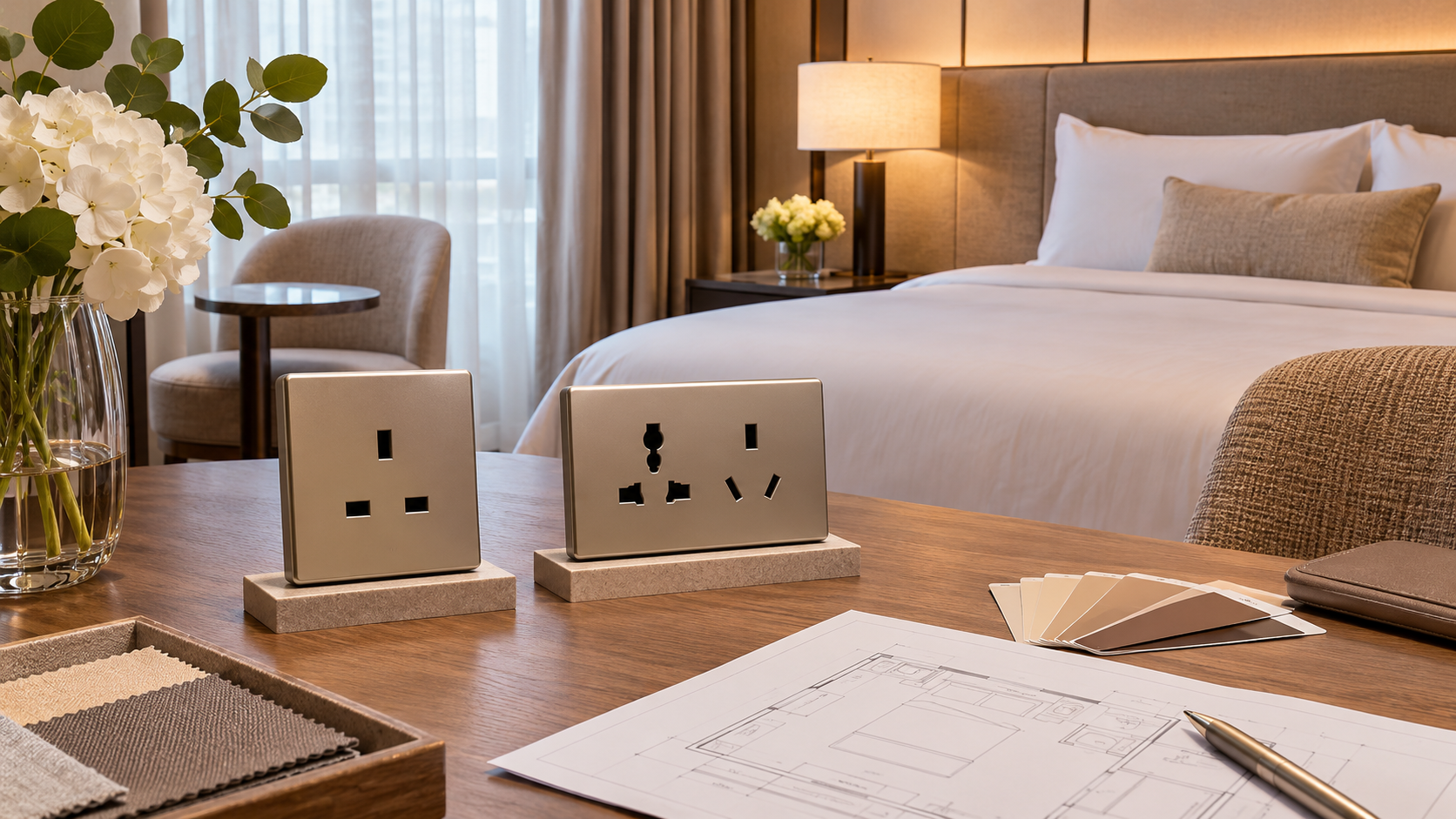
The universal socket vs local socket decision for hotel rooms should begin with the electrical rules and guest profile of the destination market. A universal-looking receptacle may accept several plug shapes, but physical fit does not establish correct earthing, protection, contact quality or approval for the room. A locally approved receptacle offers a clearer compliance path; guest convenience can then be addressed through an approved charging solution or a controlled adaptor policy. Have the local electrical designer and authority review the exact proposed device, rather than choosing from a photograph of plug holes.
Separate compatibility from permission to install
Hotel buyers often ask for one bedside outlet that works for visitors from many countries. That is a service goal, not a complete specification. List the expected devices, plug systems, supply voltage and whether guests mostly need mains power or low-voltage USB charging. Then ask which fixed receptacle system the local installation rules permit. Some 'universal' products are marketed across regions without documenting compliance in every one of them. Never treat the words universal or international as an electrical rating.
The IEC/TR 60083 catalogue documents national plug and socket systems; it is useful for understanding diversity, not a substitute for local approval. The country socket guide helps create a destination-specific schedule. Local electrical professionals should select the applicable standard, circuit protection and installation method.
Compare the actual guest experience
A local socket can provide familiar insertion force, earthing arrangement and service parts for maintenance teams. It may be inconvenient for some international guests, who then need an approved adaptor. A multi-format socket may appear convenient at check-in but can create uncertainty about shutters, contact geometry or electrical approval. Inspect the exact device documentation and physical sample, including how a bulky charger clears the headboard and how easily housekeeping can clean around it.
Where the primary need is phone charging, an approved USB module may reduce reliance on travel adaptors. USB-A and USB-C are different connector choices, and a USB-C receptacle does not automatically provide a particular Power Delivery profile. Confirm voltage, available power, control behaviour and service access for the selected module. For example, the documented MYDE MD-WL-Y003 has USB-A 5 V/2 A; that fact does not make it a mains socket or a USB-C charger. The integrated outlet guide distinguishes these functions.
Check the room circuit and maintenance route
Ask whether the receptacle remains energized when the bedside lamp is off, when the room master switch is off and when the guest removes a key card. The desired behaviour may differ for phone charging, cleaning or energy management. Confirm overload protection, earthing, accessible connections, mounting enclosure and instructions for the combined light-and-outlet assembly. A fitting with several functions can have different compliance evidence for the light, charger and mains receptacle.
Record the destination country and room type for each variant. A single multinational hotel group may need different socket plates, labels and documentation in different properties. Specify spare modules using the same approved configuration; a later replacement should not quietly introduce another plug interface. Keep installation and maintenance instructions with the as-built electrical schedule.
Questions for the supplier and local reviewer
- Which exact socket standard and national approval apply to the installed receptacle?
- What supply, current rating, earthing and protection does this variant require?
- Can the proposed module accept the target plug safely, not merely physically?
- What happens to power under each guest-room control scene?
- Are the label, installation drawing and replacement part tied to the ordered model?
If these questions cannot be answered with documentation for the destination, leave the socket choice open. A locally accepted outlet plus a clearly specified charging provision is often easier to review than an unsupported universal claim, but the final decision belongs to the local project team.