
Quick answer
Define lift, dock, switch and power-restoration states for the exact ordered headboard light before approval.
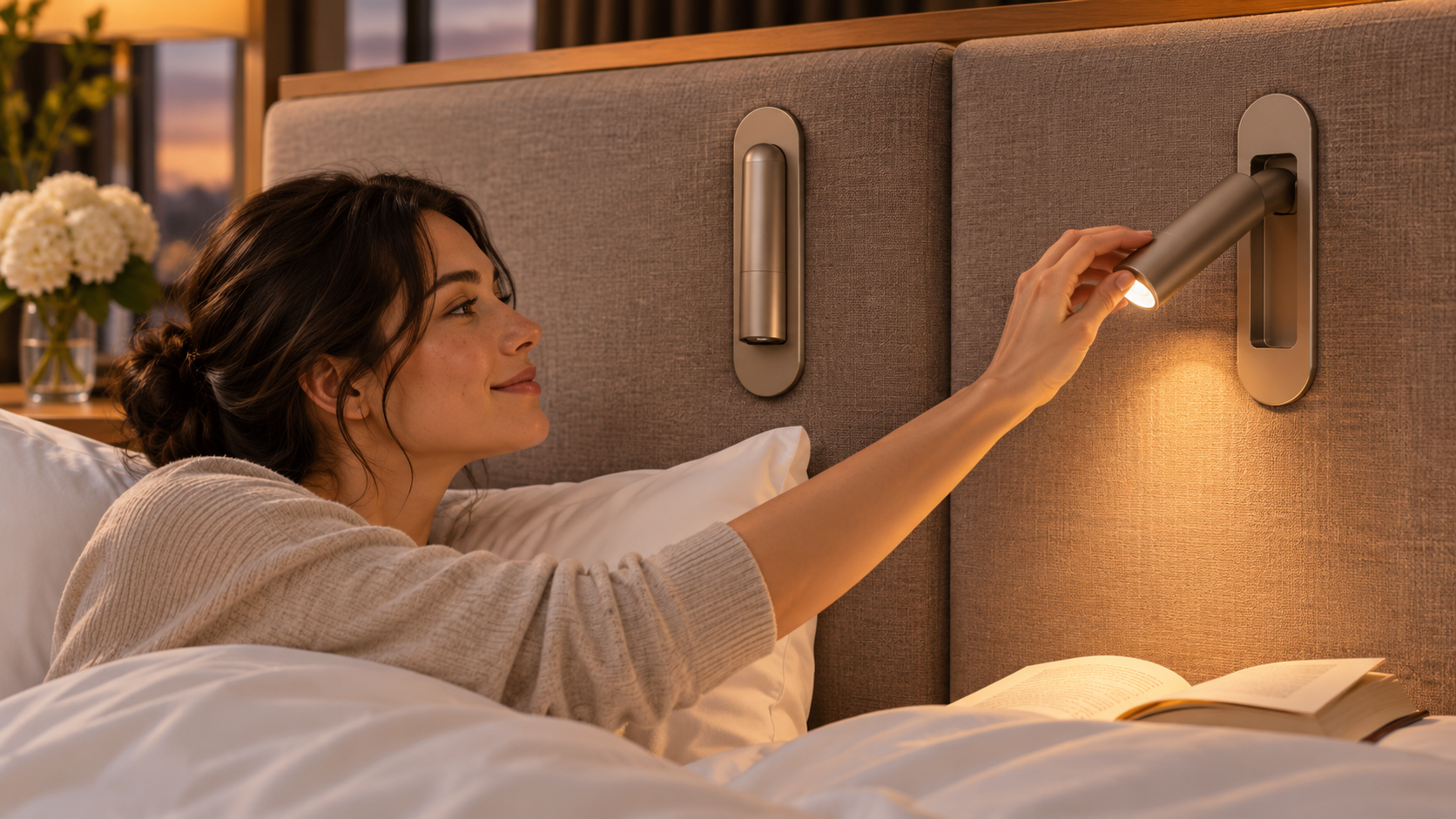
An automatic on off reading light for hotel headboards uses a physical position, sensor or room-control input to change its light state. The phrase does not identify one universal mechanism. A cradle switch may react when the head is docked, a touch or proximity device may need a separate action, and a room-management system can override local behaviour. Specify the exact sequence the guest should experience and test it with the ordered fitting and headboard. Do not infer the function from a product photograph or assume a current MYDE model has this feature without a verified configuration record.
Write the state sequence first
Describe what happens when the light is docked, lifted, aimed, returned, switched at the wall and affected by the room master control. Include the starting state after a power interruption. Does lifting the head turn it on immediately, restore the last dimming level or wait for another switch? Does docking turn it off reliably if the head is only partly seated? These are different user experiences and can have different electrical requirements. A short state table is more useful to the supplier than the word automatic alone.
Try the sequence from both guest positions. A control that works while sitting upright may be hard to operate from a pillow. A moving head can also point briefly toward the neighbouring guest during removal. Check whether a guest can turn the light off without returning it to the dock, and whether the switch gives clear feedback in a dark room. The docking-switch explainer examines one common mechanism in more detail.
Coordinate mechanism and headboard
The cradle or sensor must be positioned on the actual headboard assembly, with enough clearance for the guest's hand and for housekeeping. Upholstery thickness, timber movement, magnetic pieces or decorative metal can change how a small mechanism behaves. Ask for the manufacturer's drawing, intended mounting orientation and service instructions. Do not invent an opening from a rendered image; approve the exact cut-out and accessible wiring route for the ordered variant.
Consider repeated guest use. Can the head be returned without forcing the arm? Is the dock obvious to someone unfamiliar with the room? Will a cable be pinched by the moving component? The prototype should include the final finish, because paint, veneer or textile can affect the fit. A room mock-up is also the right place to check whether a sensor responds unintentionally to cleaning or nearby objects.
Define the electrical behaviour
Identify whether the automatic input switches mains power, sends a low-voltage signal or is interpreted by a separate driver or control system. The supplier and local electrical designer should document compatible voltage, driver, dimming and isolation arrangements. If the luminaire shares a plate with USB charging or a socket, test whether those functions remain available when the reading head turns off. A room master switch may produce a different state from the local head control.
Record how faults are diagnosed. A maintenance worker should be able to distinguish a failed light source, driver, sensor or loose dock without damaging the headboard. Specify replacement parts and access. If the head mechanism changes during procurement, repeat the state sequence and installation review, even when the external shape appears similar.
Mock-up acceptance test
Run several normal cycles of lift, aim, dim where applicable and return. Repeat after master power is removed and restored. Test a partial dock and a gentle pull from each side. Observe the beam from the neighbouring pillow during each transition, and verify that the intended night scene remains intuitive. Record the control state, furniture revision and fitting variant on the approval sheet. Where local electrical requirements require a different control arrangement, update the room schedule before ordering.
An automatic reading light succeeds when its behaviour is predictable, accessible and serviceable in the built room. The mechanism name alone is not proof of those outcomes.