
Quick answer
Constant-current drivers regulate current and constant-voltage supplies regulate voltage; select only from the exact light-engine requirements.
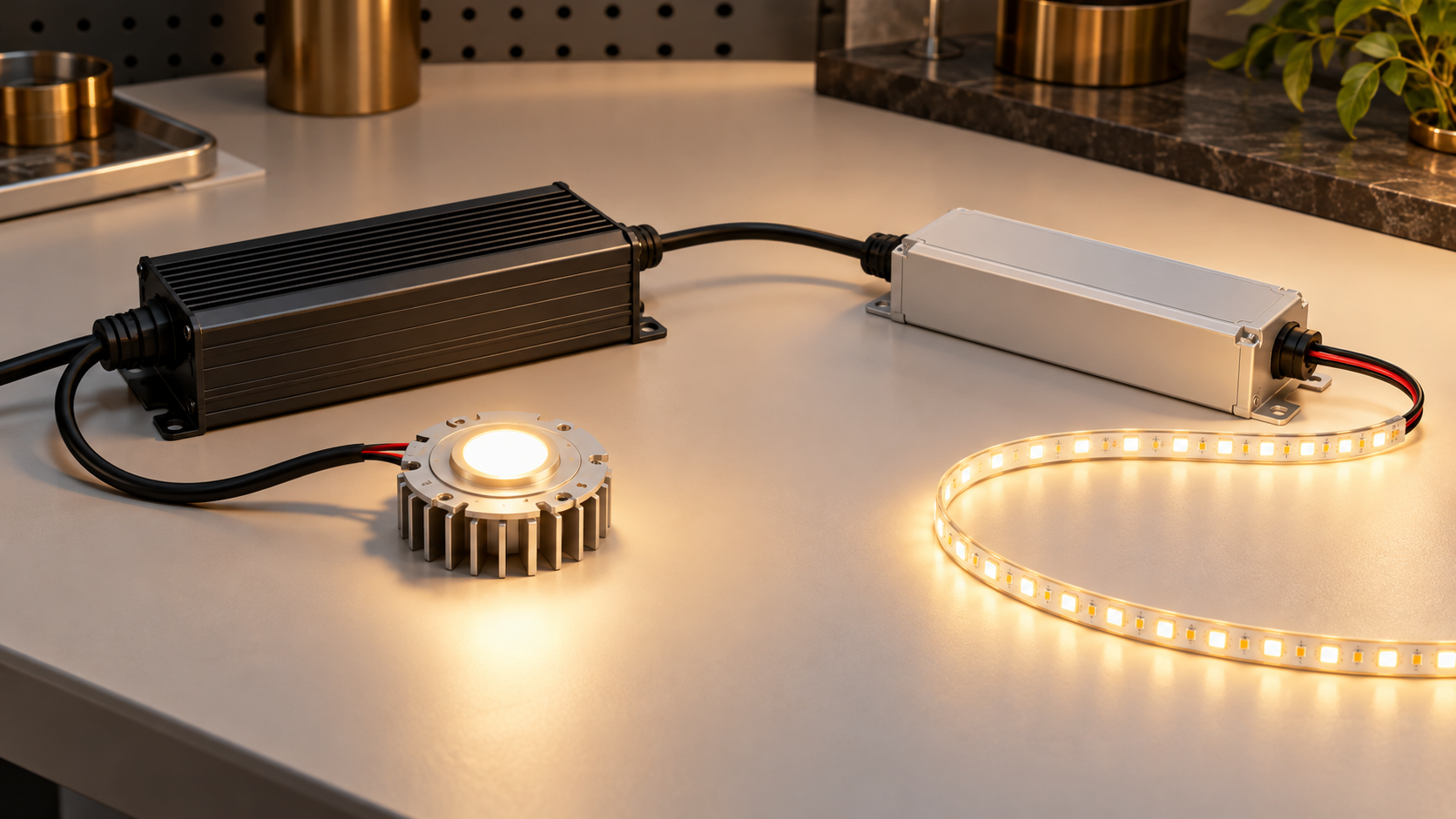
Constant current versus constant voltage for hotel lights is a driver-matching decision, not a style or brightness choice. A constant-current driver regulates output current across a stated voltage range; a constant-voltage supply regulates its output voltage and relies on the connected LED module or circuit to control current. Use the exact light engine's datasheet to select the correct approach. Never connect a luminaire to a driver just because a connector fits or the electrical power number looks similar. The ordered configuration and local electrical design decide compatibility.
Read the light engine before the driver
Find the LED module's required input and the manufacturer's approved driver specification. Record current, voltage range, wattage, polarity, connector and any control requirements. A replacement driver should meet the exact electrical and thermal requirements, not merely have the same physical size.
Signify's driver guidance explains the basic distinction between constant-current and constant-voltage outputs. This is general electrical terminology. It does not identify which architecture any specific MYDE model uses.
When constant current is specified
In a constant-current system, the driver sets the LED current while its output voltage changes within a defined range to suit the connected load. Check that the luminaire's LED string falls inside that range. Too many or too few modules can move the system outside its intended operating window. Confirm whether the driver is dedicated to one reading head or serves multiple loads, and follow the product documentation rather than improvising a series arrangement.
If dimming is required, check the exact driver's control input and its behavior with the selected LED module. A dimmable label on a driver is not enough to guarantee a smooth low end in the room.
When constant voltage is specified
A constant-voltage supply is common where connected modules are designed for a fixed input voltage and include their own current regulation. Check the rated voltage, total connected load, cable length and voltage drop. The electrical designer should also consider protection and distribution for the installation. Do not apply a fixed-voltage supply to a bare constant-current LED array.
In a hotel, long cable runs to remote drivers or repeated modules can make distribution details important. A generic diagram cannot prove that the supplied product supports a particular topology. Request an approved wiring diagram for the exact fixture and room arrangement.
Compare the complete project implications
For either approach, ask where the driver will sit, how heat is managed and how a failed component will be accessed. Record input-side power data and any relevant compliance documents for the destination market. The integrated versus remote driver guide explains how location changes service and joinery decisions; it does not change the need to match electrical output.
Keep the selected driver part number in the fixture schedule and sample record. If a supplier proposes a substitute during production, compare the full output and control specifications, retest the actual lamp and obtain qualified approval before accepting it. No current MYDE product evidence cited here establishes a universal driver type across the catalogue.