
Quick answer
Identify the exact approved driver and control scheme, isolate power and have qualified personnel verify compatibility before replacement.
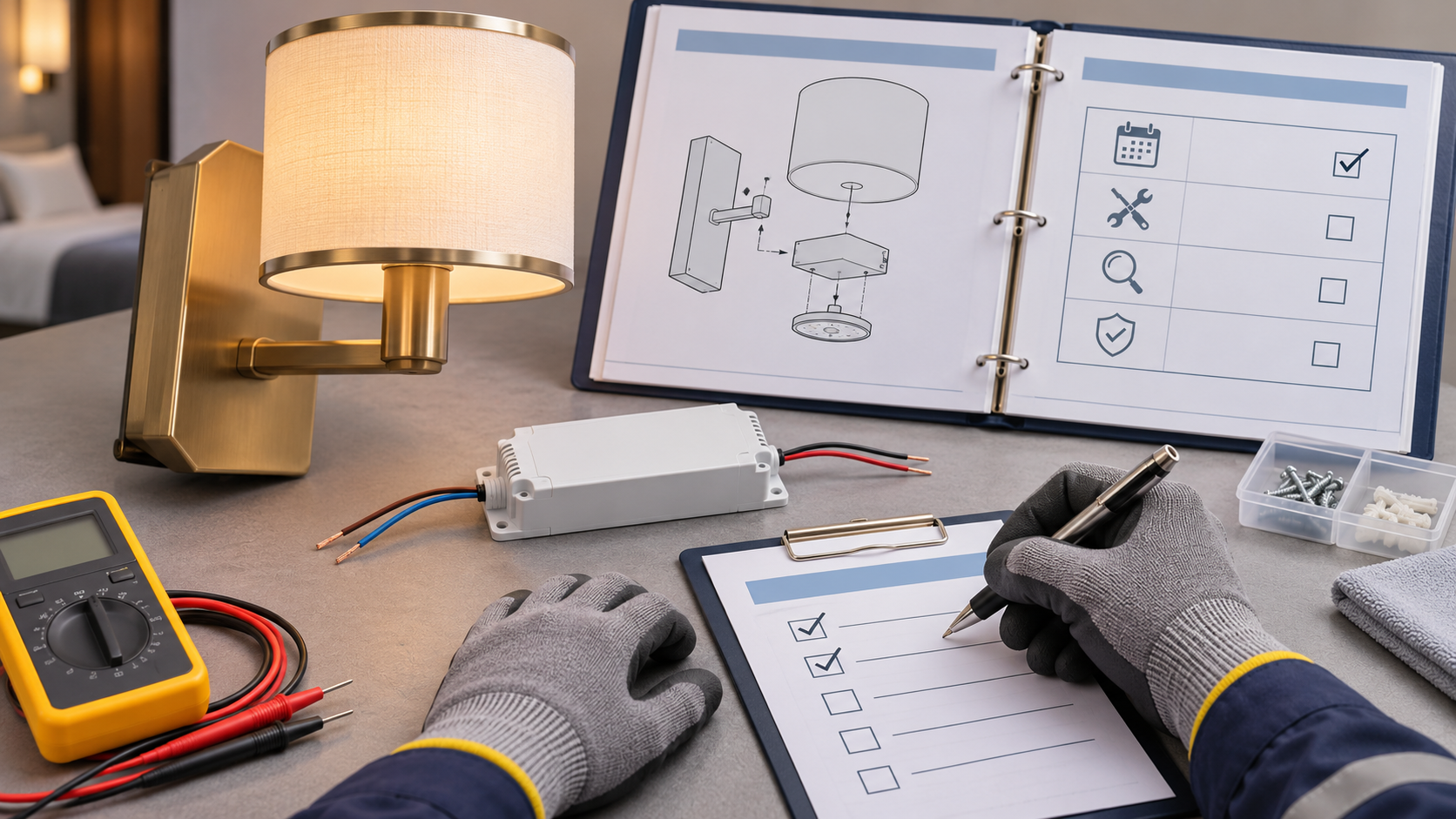
How to replace LED drivers in hotel wall lights begins with identifying the exact luminaire and its approved electrical design. The driver is not a generic interchangeable box. Its input, output, control protocol, physical location, thermal conditions and market approval must match the replacement specified by the manufacturer. A qualified electrical worker should isolate the circuit and follow local rules and the product instructions. This article provides a planning and verification checklist for hotel facilities teams; it is not a live-wiring procedure or an installation drawing.
Confirm the driver is the failed component
No light, flicker or intermittent operation can also come from a switch, LED module, connector, supply or room-control system. Record the symptom and check the room scene before ordering a part. Ask a qualified technician to diagnose safely. If several rooms show the same fault, review whether a shared control setting or supply condition is involved. Do not use a new driver as a diagnostic shortcut when the cause is unconfirmed.
Keep the original model number, luminaire variant, driver part number and revision in the service log. A later production batch may have a different approved driver. The common-failures guide gives the wider triage framework.
Match electrical and control requirements
Obtain the manufacturer's replacement specification for that exact fitting. Confirm input supply, output mode and range, current or voltage as applicable, dimming protocol, connectors, protection and permitted installation location. A connector that fits does not establish electrical equivalence. If the wall light shares a USB module, outlet or room-management circuit, confirm how those functions are isolated and controlled. Substituting a different driver may affect light output, flicker, colour appearance or compliance of the final assembly.
The local electrical designer should check destination-market rules and any need for retesting or documentation updates. Never assume a component certificate for a proposed driver covers the whole luminaire. Use the current approved instructions rather than a photograph of another product's wiring.
Check physical access before work starts
Determine whether the driver is inside the fitting, behind the backplate or in a separate accessible void. The position affects room downtime and finish risk. Ask whether the bed, headboard panel or wall covering must be removed. A successful maintenance plan provides a safe access route and a method to restore the surface. If access is blocked by a later furniture alteration, escalate the design issue instead of cutting into the room without approval.
Record any heat damage, loose connection or moisture found by the qualified worker. The cause may be environmental or installation-related, and a simple part swap may not solve it. Dispose of the failed component under the site's electrical-waste procedure and retain it if supplier analysis is required.
Verify the room after replacement
After work under the manufacturer's procedure, test on/off, dimming where present, room master scenes and adjacent charging functions. Compare the repaired side with the matching bedside light for brightness and colour appearance. Confirm that the backplate, shade and aiming position are restored and that no guest-accessible part is loose. Update the service record with the new part, date, technician and any deviation.
The spare-parts guide explains how to keep compatible replacements available. A documented, qualified repair is preferable to an untraceable substitute that merely makes the light turn on.