Quick answer
Define the guest's scenes first, then verify a compatible fixture, driver and control pairing. Mock up the full circuit for smoothness, low output, flicker and power-restoration behaviour.
Dimming options for hotel bedside wall lights should be chosen from the guest's required scenes and the exact light, driver and control pairing. A dimming label on a luminaire does not show whether the installed combination will start smoothly, remain steady at low output or turn fully off. Decide what each guest needs to control, request compatibility evidence, and test the complete circuit in a sample room before specifying repeated units.
Write the guest sequence first
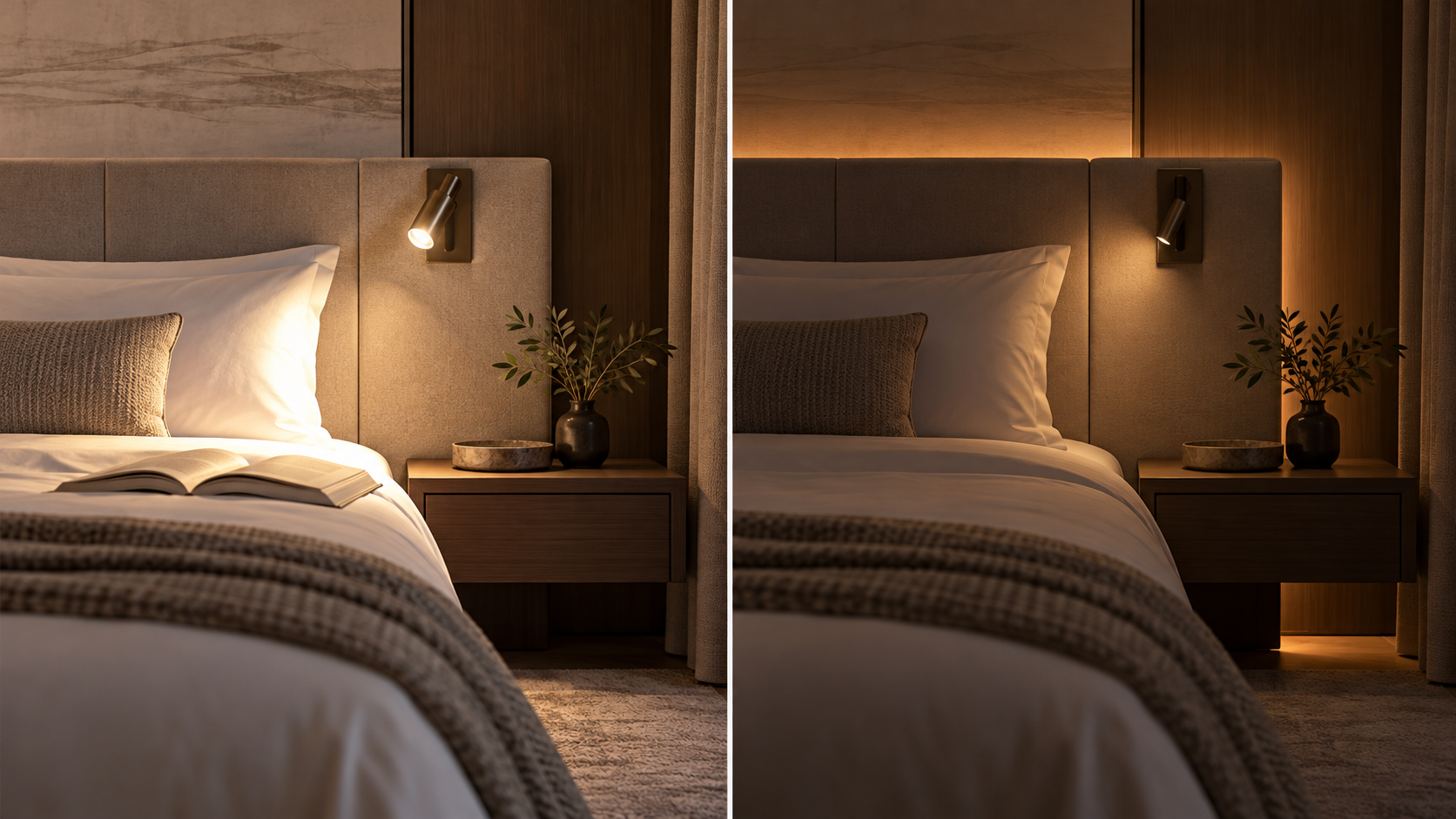
State whether the reading head needs adjustable brightness or only on/off. Decide how the ambient and decorative layers respond, whether each side of the bed is independent and what the room master does. A dimmer that changes both reading lights together may be wrong for a room where one person is asleep. Define the intended low level and how a guest returns to a useful reading setting.
Then identify the electrical method for each candidate: integral touch control, phase-cut, 0–10 V, DALI or another specified system. These are not interchangeable labels. The driver, controller, wiring and load range must match. The DALI Alliance describes addressable digital dimming and scenes, but a DALI room design only works with compatible devices and commissioning. For a system-level comparison, see the 0–10 V versus DALI guide.
Test the actual circuit over its full range
The US Department of Energy's LED phase-cut dimming guidance says compatibility alone does not guarantee smoothness, lack of flicker or a desired minimum level and recommends full-circuit mock-ups. In the guest room, watch for flicker, abrupt jumps, delayed start, dropout, ghosting, sound and inconsistent behaviour after power restoration. Test one light and the intended group load.
Review the low setting with the room dark and a real book at the pillow. A lower output may be useful for ambience but inadequate for reading; the control should allow a guest to recover the task setting. Check the adjacent pillow for spill and the switch for discoverability. A visual test can identify obvious problems, while a project with a measured flicker criterion needs the specified measurement method and documented results.
Keep model facts separate
The documented MD-WL-Y003 configuration is non-dimmable. It should not be put on a dimming schedule by assumption. The MD-WL-Y092 pack describes touch dimming, but the exact sequence and compatibility for the ordered version require confirmation. The MD-WL-Y135 fact pack does not establish a dimming method. Ask for the current driver and control documentation before assigning any of these models to a room scene.
Release a maintainable control specification
- Name the exact luminaire, driver, dimmer or controller and software revision if relevant.
- Record the full guest operation and master-control sequence.
- State the acceptable low end and how it was tested.
- Keep a signed room mock-up and supplier compatibility evidence.
- Require retest when a driver or control component is substituted.
The right dimming option is the one that delivers the intended guest experience with the verified electrical combination and can be reproduced during maintenance.