
Quick answer
Do not accept “flicker-free” as a complete performance specification. Ask for temporal-light measurements at the expected operating and dimming levels, using the exact LED driver, luminaire and controls. Review the results and a room sample against the project's criteria.
“Flicker-free LED lighting for hotel rooms” sounds like a clear buying requirement, but the phrase alone does not define a test. Light output can vary over time in ways that are visible or produce other temporal artifacts. The LED driver, dimmer and operating level all affect the result. Ask for measured data for the exact system and agree the project's acceptance criteria before ordering.
Understand the phenomenon
The U.S. Department of Energy's flicker explanation distinguishes changes in emitted light from the visual effects people may notice. A lamp that looks steady to one observer in one scene has not been proven free of temporal modulation in every condition.
When reviewing a supplier claim, ask which metric was measured, the instrument and method, the operating point, and the result. Record the driver, supply, dimmer and controller used in the test. A product tested at full output may behave differently at a low dimming level. An LED board result cannot be assumed to describe the installed luminaire and control combination.
Identify the room's critical conditions
List the scenes a guest will use: arrival, low evening light, bedside reading and night movement. If the room uses dimming, include the lowest stable level expected in service. Check how the light starts, switches off and returns after a power interruption. The room's electrical supply and control architecture should be represented in the test where practical.
Review the exact luminaire and driver data with the lighting designer. There is no useful universal promise in calling every LED product “flicker-free.” If a project has a particular requirement, write its measurement method and threshold into the specification rather than asking suppliers to confirm a marketing adjective.
Test the complete combination
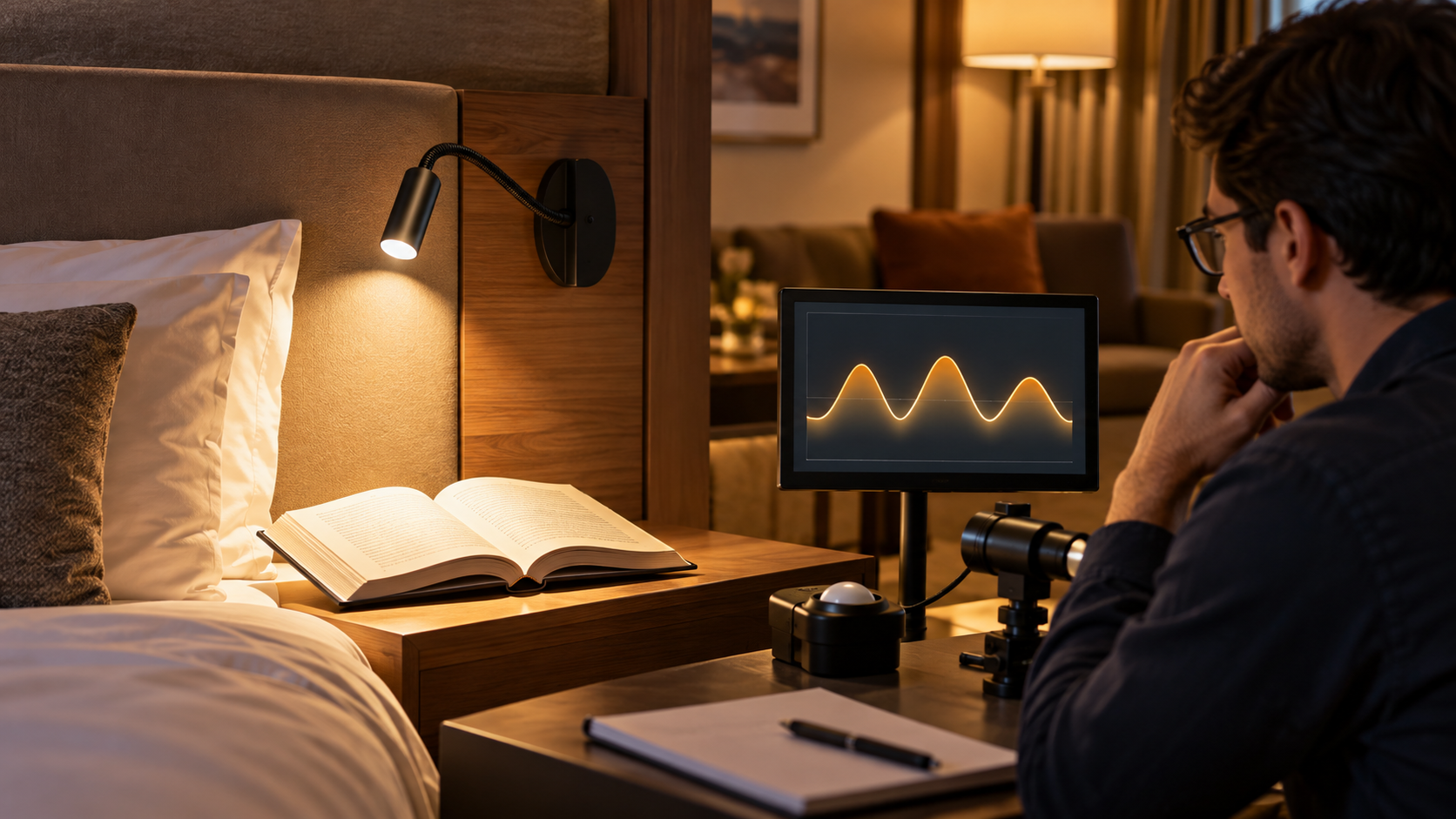
Set up the intended driver, dimmer and luminaire in a mock-up. Observe the reading surface, moving hands and any reflective materials while changing levels. This visual review can expose obvious problems, but it is not a substitute for instrumented temporal-light measurements where a criterion is specified.
The DOE flicker research collection provides background on metrics and testing. Ask a competent lighting professional to interpret the submitted results in the context of the project. Keep the report with the exact equipment schedule so a later driver substitution cannot silently change the accepted behaviour.
Avoid unsupported model claims
The MYDE product information reviewed for this batch does not establish temporal-light performance for an exact driver and dimmer pairing. We therefore do not describe any current MYDE model as measured flicker-free here. Request a configuration-specific report if this is a project acceptance condition.
At procurement, state the operating levels, control combination, required evidence and mock-up pass criteria. The driver selection guide explains the other electrical and service questions that belong in the same review.
Make the acceptance record specific enough to survive substitutions. A replacement driver, updated controller firmware or revised LED module may require a new measurement. Keep the original report with the approved component list, and have the lighting professional decide whether a changed system still meets the room requirement.